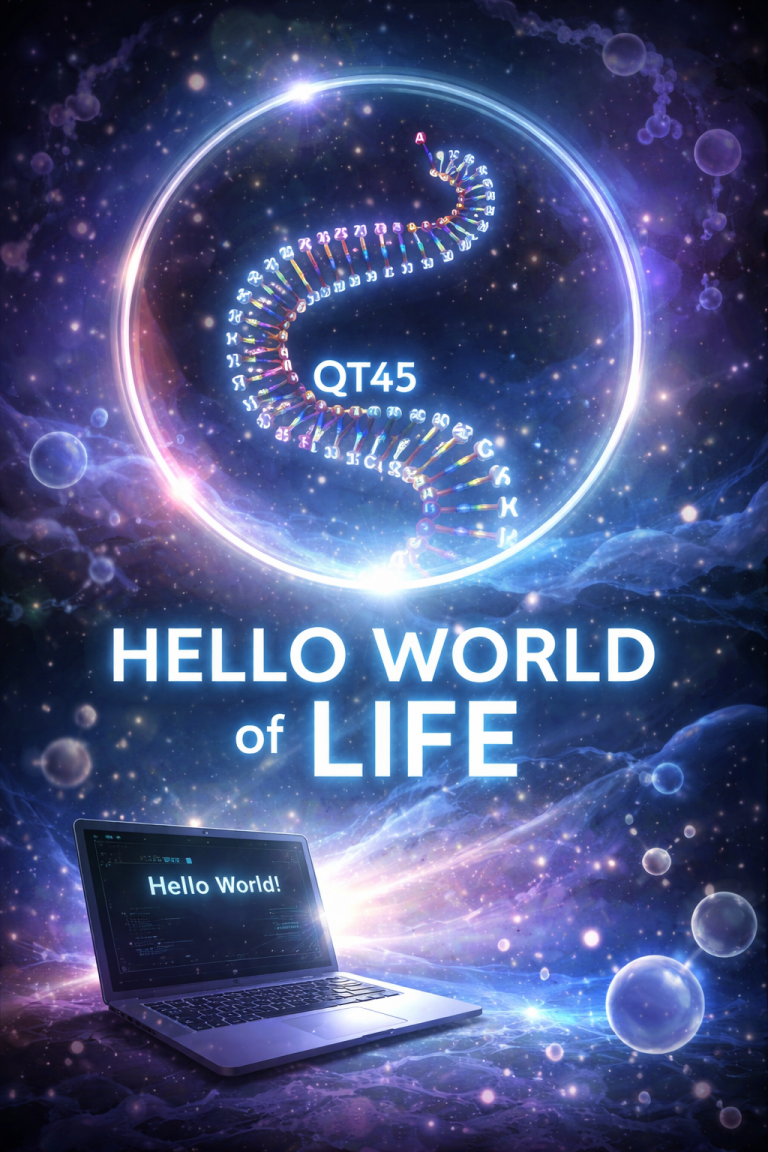
A few days ago, I came across something that has been quietly occupying my thoughts ever since. Researchers in the UK identified what is currently the shortest RNA molecule known to copy itself. It is called QT45, and it consists of just forty-five nucleotides.
Forty-five.
If you’re not immersed in molecular biology, that number may not immediately sound impressive. So let me give you context.
The human genome contains roughly three billion base pairs of DNA. Even a single human gene that codes for a protein can consist of thousands of nucleotides. Many RNA molecules in our cells are hundreds or thousands of nucleotides long. Even relatively simple organisms — like amoebae — rely on genomes that are millions of base pairs in length.
And then there is QT45.
Forty-five nucleotides.
That’s not a genome.
That’s barely a paragraph in molecular language.
And yet, it can do something extraordinary: it can copy itself.
That is why this discovery matters.
Because every form of life — without exception — depends on the ability to reproduce.
Some organisms divide by simple scission, splitting into two identical parts. Others reproduce through budding. Many rely on gametes — sperm and egg — combining genetic material in complex ways. Some bacteria exchange genetic material laterally. Plants spread through spores. Fungi release clouds of microscopic propagules. Even viruses, although they blur the definition of life, depend entirely on replication inside host cells.
But before there were gametes, before multicellular organisms, before even cells as we know them — there must have been something simpler.
Life could not have begun with complexity.
Whatever the first step was, it had to be something capable of making more of itself. Something that could produce individuals similar or identical to the original. Without replication, there is no heredity. Without heredity, there is no variation. Without variation, there is no evolution.
Replication is the gateway.
That’s why a tiny RNA molecule that can copy itself is not just a biochemical curiosity. It is a glimpse into what the earliest beginnings of life might have looked like — a minimal system that crossed the threshold from chemistry into biology.
When I read about QT45, my mind did what it always does. It started connecting dots.
If you’ve ever written code, you might remember the tradition of beginning with a simple program that prints “Hello, world.” It doesn’t solve a real-world problem. It doesn’t scale. It doesn’t optimize anything. It simply proves that the system runs.
QT45 feels like the “Hello World” of life on Earth.
Not a full organism. Not an ecosystem. Not consciousness.
Just a minimal script that says: replication works.
And once replication works, everything else becomes possible.
Variation can enter. Errors — or mutations — can occur. Some variants persist better than others. Selection begins to shape what survives. Systems become more complex, not because they were designed that way, but because iterative changes accumulate over time under specific conditions.
Evolution is not a master plan. It is a process of trial, feedback, retention, and adaptation. It is contextual. It is opportunistic. It is responsive.
In that sense, evolution is astonishingly agile.
And this is where the scientific story becomes personally interesting to me.
How often do we assume that meaningful change in our lives requires a fully formed strategy? A complete identity shift? A perfectly mapped-out future?
We wait for complexity before we allow ourselves to begin.
But life itself may have begun with something astonishingly small.
Not a grand architecture.
Not a five-year plan.
Just forty-five nucleotides capable of copying themselves.
It makes me wonder whether we consistently overestimate the size of the beginning required for transformation.
Maybe the real question is not: “What is the final version of who I want to become?”
Maybe the better question is: “What is the smallest version of this change that can replicate?”
In innovation, we speak of minimum viable products. In systems thinking, we search for leverage points — the smallest intervention that shifts the whole. In personal growth, it might be one honest conversation, one boundary clearly expressed, one experiment run without overengineering it.
QT45 is not impressive because it is complex.
It is remarkable because it crosses a threshold.
From static chemistry to dynamic continuation.
From existence to propagation.
From possibility to persistence.
And perhaps that is all a beginning ever needs.
This is also how I want this blog to unfold. Not with a rigid master plan or a predefined strategy. I am more interested in observing what resonates, listening to feedback, adjusting direction, and allowing useful mutations to survive. If a particular line of thought sparks energy, it will evolve. If it does not, it will quietly disappear.
Evolution does not commit to a single path in advance. It experiments.
QT45 may be small. But it invites a large question:
What is the “Hello World” of the next version of your life?
Not the final form.
Just the smallest viable beginning that can produce another step.
Because if forty-five nucleotides were enough to start the long arc of biological evolution, perhaps we need less than we think to begin our own.
If you’re thirsty for more…
📖 Read (clear explanations)
• What is the RNA World Hypothesis? — A friendly overview of the idea that life may have started with self-copying RNA, explaining why that matters for origins and evolution. https://biologyinsights.com/the-rna-world-hypothesis-explaining-an-origin-of-life
• Origins of life and self-replication basics — An approachable summary of how simple molecules could have started to copy themselves and kick-start evolution. https://evolution.berkeley.edu/from-soup-to-cells-the-origin-of-life/how-did-life-originate
🎥 Watch (visual learners)
• What Is the RNA World Hypothesis? (short explainer) — A simple animated video that captures the core idea of life potentially beginning with RNA’s dual roles in chemistry and replication. https://www.youtube.com/watch?v=K1xnYFCZ9Yg
• Where Did Life Come From? (PBS / Eons) — A big-picture video journey through early life and the RNA world concept, great for beginners. https://www.youtube.com/watch?v=_uAJY1mqtw4
🎧 Listen (audio / podcast)
• “The RNA World Hypothesis and the Origin of Life” (BioAudio) — A ~30-minute podcast episode exploring life’s earliest spark and how self-copying molecules may have led to evolution, perfect for listening while walking or commuting. https://podcasts.apple.com/us/podcast/the-rna-world-hypothesis-and-the-origin-of-life/id1702939428?i=1000628873171


